
What is cold email infrastructure and why does it matter for outreach success? Cold email infrastructure refers to the technical foundation behind outbound email campaigns.
Introduction
Cold email infrastructure is the technical foundation that determines whether your outreach campaigns succeed or fail. While most businesses focus on email copy and prospect lists, email providers focus on authentication, sender reputation, and domain behavior.
If the infrastructure behind your cold email campaigns is weak, even well written messages will land in spam. Understanding how cold email infrastructure works is essential for anyone running outbound campaigns.
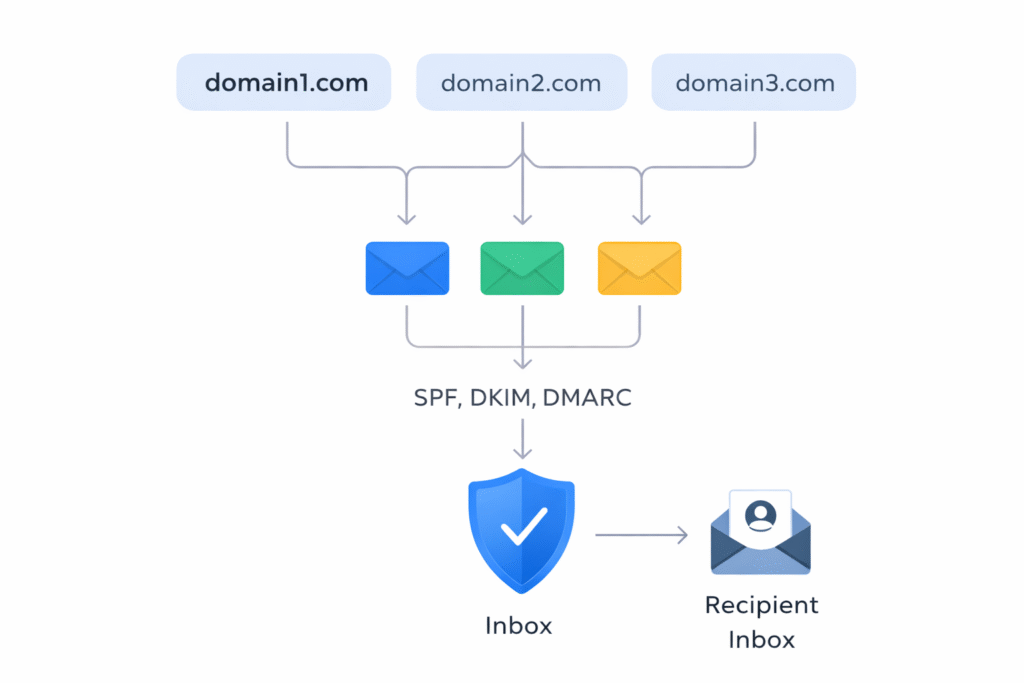
What Is Cold Email Infrastructure
Cold email infrastructure refers to the complete technical setup behind an outbound email system. It includes domains, inboxes, DNS records, authentication protocols, sending limits, and reputation management.
A professional cold email infrastructure setup includes:
- Dedicated sending domains
- Multiple inboxes per domain
- SPF configuration
- DKIM signatures
- DMARC enforcement
- Inbox warmup processes
- Inbox warmup processes
These components work together to signal legitimacy to email providers like Google Workspace and Microsoft 365 (Outlook).
Without proper setup, cold emails are filtered before recipients ever see them.
Why Infrastructure Matters More Than Copy
Many teams believe poor open rates are caused by weak subject lines. In reality, deliverability is often the issue.
Email providers evaluate:
- Domain age
- Authentication alignment
- Sender history
- Bounce rates
- Complaint rates
- Sending consistency
If your domain lacks proper authentication or shows sudden high sending volume, your messages may be flagged as suspicious.
Cold email infrastructure ensures that technical signals align with provider expectations.
Core Components of Cold Email Infrastructure
1. Domain Strategy
Professional setups rarely send from the main business domain. Instead, separate domains or subdomains are used to isolate reputation.
For example:
Main domain: company.com
Sending domain: company-mail.com
This protects the primary brand domain from reputation damage.
2. SPF, DKIM and DMARC
Authentication records validate that your emails are legitimate.
SPF defines which servers can send emails for your domain.
DKIM adds a digital signature to verify message integrity.
DMARC enforces policy and defines how failed authentication is handled.
When these records align properly, deliverability improves significantly.
3. Inbox Allocation
Instead of sending large volumes from one inbox, professional cold email infrastructure distributes volume across multiple inboxes.
A common structure:
2 to 3 inboxes per domain
25 to 40 emails per inbox per day
This reduces risk and supports scaling.
4. Inbox Warmup
New inboxes must gradually build reputation. Sending high volume from a brand new inbox triggers spam filters.
Warmup involves:
• Gradual daily volume increase
• Positive engagement signals
• Low bounce rates
Without warmup, even authenticated domains may struggle.
5. Reputation Monitoring
Cold email infrastructure is not a one time setup. Ongoing monitoring ensures domains remain healthy.
Metrics to track include:
• Bounce rate
• Spam complaint rate
• Open rate stability
• Domain blacklist status
Stable reputation allows long term outreach.
Cold Email Infrastructure vs Email Marketing
Traditional email marketing sends to opt in lists. Cold email targets new prospects.
Because cold email involves unsolicited outreach, infrastructure must be more controlled.
Email marketing tools may not require multiple domains or strict volume control. Cold outreach demands stronger infrastructure discipline.
How to Scale Cold Email Infrastructure Safely
Scaling is not about increasing volume per inbox. It is about adding more domains and distributing load.
Safe scaling involves:
• Adding new domains gradually
• Creating new inboxes per domain
• Warmup before sending campaigns
• Maintaining low daily limits
This approach supports long term deliverability without harming reputation.
Common Mistakes That Destroy Deliverability
• Sending 100 plus emails from a new inbox
• Skipping DMARC configuration
• Using the main business domain
• Ignoring bounce rates
• Overlapping sending schedules
Avoiding these mistakes protects domain health.
Final Thoughts
Cold email infrastructure determines whether your campaigns reach the inbox or disappear into spam folders. It is the technical backbone of outbound success.
By structuring domains correctly, aligning authentication records, controlling sending volume, and monitoring reputation, businesses can build stable and scalable cold outreach systems.
Without infrastructure discipline, growth becomes unpredictable.
If you are running outbound campaigns, investing in professional cold email infrastructure is not optional. It is essential.